Monstração
Rafa Bqueer: devir-Mapinguari
Renato Menezes
Rafa Bqueer: devir-Mapinguari
“No gueto, tudo está em falta, exceto a sensação. A experiência é abundante. A terrível beleza está além do que qualquer um poderia esperar assimilar, ordenar e explicar »1.
Ninguém ousará negar tê-la visto. Tudo sugere sua presença, mas nada prova suficientemente sua existência: sinal-traço-indício; bicha-coisa-gente; causo-enigma-visão. Tudo junto, sem jamais ser o que parece; sem jamais parecer o que de fato é.
Conta-se que, em diversas partes da Amazônia, do Pará à Bolívia, passando pelo Mato Grosso e por Rondônia, vive escondida no meio da mata densa uma criatura monstruosa: seu corpo é revestido de pelos, na fronte carrega um olho gigante e no lugar umbigo traz uma cavidade bucal por onde devora qualquer potencial predador. Sua forma incomum escapa a quem quer que deseje descrevê-la: uma preguiça gigante ou um herdeiro dos extintos gigantopithecus? Um ciclope ou um cinocéfalo? Não se sabe. O que dizem é que seus urros afugentam invasores, caçadores e madeireiros, protegendo a floresta. Chamam-na Mapinguari, a temível e indócil fera, inimiga primeira do homem e da norma, de pele de coatá, unhas de onça e pés virados para trás.
Em Monstração, as obras de Rafa Bqueer são mobilizadas por um “devir-Mapinguari”. Explico-me. Há pelo menos dez anos, Bqueer elabora em seu trabalho uma fusão entre as culturas amazônicas, especialmente do Pará, onde nasceu, e os ícones carnavalescos do Rio de Janeiro, onde reside. Entre um lugar e outro, entre os contos e cantos da floresta e o samba carioca, emerge um não-lugar, um estado de transformação permanente, de metamorfose, um espaço da invenção, da quimera, onde se renova constantemente um compromisso com o irreal, com o absurdo. É lá onde se manifesta isso que chamei de “devir-Mapinguari”, um conceito operativo de sua produção, um dispositivo de fabulação, que borra irreversivelmente as fronteiras entre o mito e história e define o elemento contra-canônico, o criaturesco, o disforme que a constitui. O “devir-Mapinguari” nomeia a forma – o subalterno, o estranho, o alienígena, o indomesticável –, assim como a experiência que essa forma produz: o corpo rejeitado, que ameaça a humanidade, é devolvido a esta última como origem do medo, como contra-ataque. No “devir-Mapinguari”, o corpo apontado, exibido, ridicularizado, inverte essa relação de poderes e monta-se, mostra-se, monstra-se. A arte da montação é um recurso do “devir-Mapinguari”, na medida em que os aparatos, apetrechos, badulaques e frufrus tornam-se próteses de proteção, armaduras, mas também artefatos de produção de agência, de intimidação. Se o Mapinguari é a força da floresta que se levanta contra a destruição e o ímpeto expansionista colonial, o “devir-Mapinguari” é o estado das coisas que reagem contra a predação, o extrativismo e o desencante. No “devir-Mapinguari” o dia do caçador não chega nunca: todo dia é dia da caça.
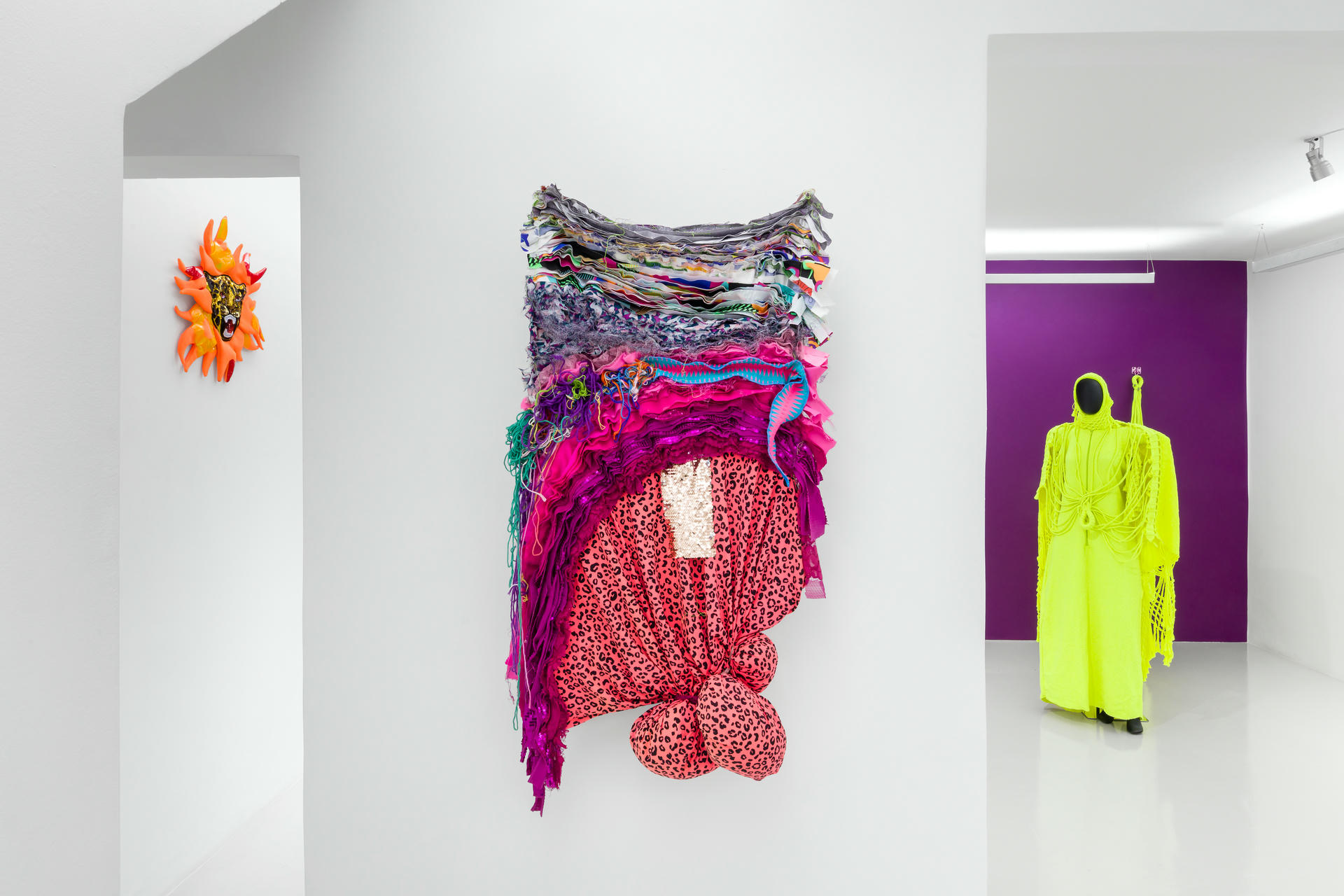
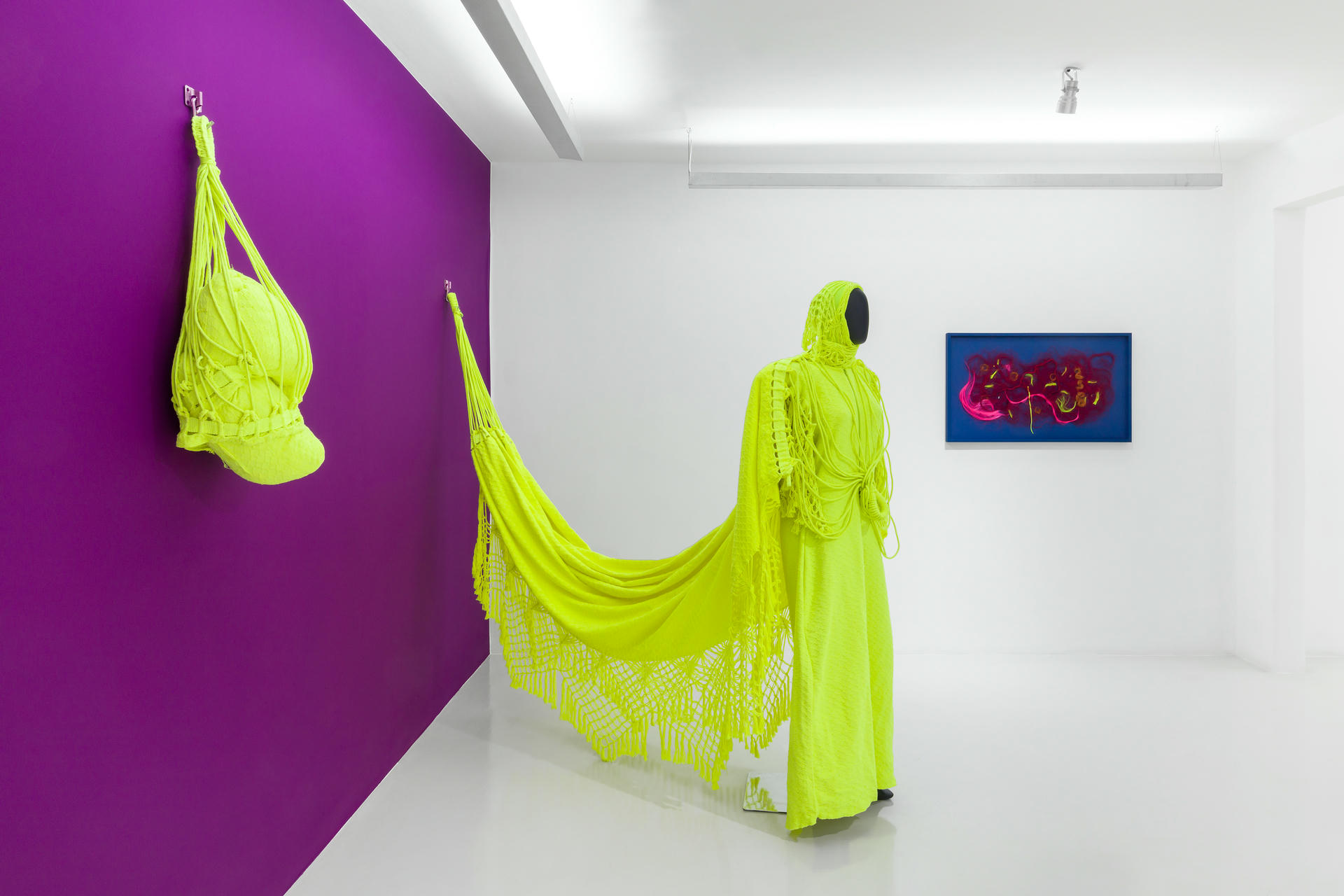
Entre os trabalhos apresentadas em Monstração, distinguem-se três grupos: o primeiro, que constitui um desdobramento importante na obra de Bqueer, é o de obras residuais. Cabelos, dentes e garras são formas de produção de uma ficção arqueológica do Mapinguari ao mesmo tempo em que ressignificam restos, retalhos e resquícios carnavalescos. Essas obras residuais não deixam de ser, em igual medida, mecanismos de criação de memória das práticas de sociabilidade das Themônias, coletivo paraense surgido em 2014, propondo uma abordagem suja, impura e transumana da cultura paraense. Um segundo grupo de trabalhos, que decorre desse primeiro, é o de obras representativas: Uhura Bqueer, seu alter-ego, figura themonia por excelência, aparece pela primeira vez em cena, deglutindo todas as referências que aparecem, da cestaria tradicional paraense à crítica ao império colonial português através dos célebres Azuleijões de Adriana Varejão, passando, naturalmente, pela monstra com garras de caranguejo. Um terceiro e último grupo, inédito, são o de obras emblemáticas: trata-se de experimentações têxteis que aprofundam suas pesquisas sobre cenografias de ballroons, de figurinos e de estandartes. Sobreposições de franjas de tecido criam diferentes estratos de cor e textura em uma costura obcecada que revisita uma sólida escola de pintura brasileira, iniciada nos anos 1980 e capitaneada por Leda Catunda e suas pinturas moles.
Juntos, esses três conjuntos resultam de um trabalho de caça, ingestão, assimilação, transmutação e jorro de referências diversas que reafirmam o “devir-Mapinguari” que percorre os veios de sua produção. No meio da floresta ou nas beiradas da cidade, o trabalho de Rafa Bqueer reelabora o monstruoso, o tenebroso e o repulsivo, vira do avesso a forma da norma e mostra, nas entranhas, o destino de quem ousar aviltar seu nome.
Renato Menezes, historiador da arte e curador
Rafa Bqueer: Devir-Mapinguari
“In the ghetto, everything is in short supply except sensation.
Experience is abundant. The terrible beauty is beyond what anyone could hope to assimilate, order and explain”1.
No one will dare deny having seen it. Everything suggests its presence, but nothing sufficiently proves its existence: sign-trace-indication; faggot-thing-guy; story-riddle-vision. Altogether, without ever being what it seems; without ever seeming to be what it actually is.
Rumor has it that in several parts of the Amazon, from Pará to Bolivia, going through Mato Grosso and Rondônia, a monstrous creature lives hidden in the middle of the dense forest: its body is covered with hair, it carries a giant eye on its forehead and it has a mouth cavity in its belly button through which it swallows any potential predator. Its unusual shape eludes anyone who wishes to describe it: a giant sloth or an heir to the extinct gigantopithecus? A cyclops or a cynocephalus? No one knows. What they do say is that its howls scare away invaders, hunters and loggers, protecting the forest. They call it Mapinguari, the fearsome and indocile beast, the first enemy of man and the norm, with coatá skin, jaguar nails and feet turned backwards.
In Monstração, Rafa Bqueer’s works are mobilized by a “devir-Mapinguari”. Let me explain. For at least ten years, Bqueer has been working on a fusion between the cultures of the Amazon, especially Pará, where she was born, and the carnival icons of Rio de Janeiro, where she lives. Between one place and another, between the tales and songs of the forest and Rio’s samba, a non-place emerges, a state of permanent transformation, of metamorphosis, a space of the invention, the chimera, where a commitment to the unreal, to the absurd, is constantly renewed. It is there that what I have called “devir-Mapinguari” manifests itself, an operative concept of her production, a device of fabrication, which irreversibly blurs the boundaries between myth and history and defines the counter-canonical, the creaturely, the shapeless element that constitutes it. The “devir-Mapinguari” names the form – the subaltern, the stranger, the alien, the indomesticable – as well as the experience that this form produces: the rejected body, which threatens humanity, is returned to the latter as the source of fear, as a counterattack. In “devirMapinguari”, the body that is singled out, exhibited, ridiculed, inverts this relationship of powers and assembles itself, shows itself, shows itself off. The art of montage is a resource of the “devir-Mapinguari”, insofar as the apparatuses, paraphernalia, trinkets and frills become protective prostheses, armors, but also artifacts to produce agency and intimidate. If the Mapinguari is the force of the forest that rises up against destruction and the colonial expansionist impetus, the “devir-Mapinguari” is the state of things that reacts against predation, extractivism and disenchantment. In “devir-Mapinguari”, the hunter’s day never comes: every day is the day of the hunt.
Among the works presented in Monstração, three groups stand out: the first one, which constitutes an important unfolding in Bqueer’s work, is that of residual works. Hair, teeth and claws are ways of producing an archaeological fiction of the Mapinguari, while at the same time re-signifying remains, scraps and carnival remnants. These residual works are also mechanisms to create memory of the sociability practices of the Themônias, a collective from Pará that emerged in 2014, which proposed a dirty, impure and transhuman approach to Pará culture. A second group of works, which stems from the first, is that of representative works: Uhura Bqueer, her alter-ego, a themonic figure par excellence, appears on stage for the first time, swallowing all the references that appear, from traditional Pará basketry to a critique of the Portuguese colonial empire through Adriana Varejão’s famous Azuleijões, including, of course, the monster with crab claws. A third and final group, which has never been seen before, are emblematic works: these are textile experiments that delve deeper into her research into the scenography of ballrooms, costumes and banners. Overlays of fabric bangs create different layers of color and texture in an obsessive stitching that revisits a solid school of Brazilian painting that began in the 1980s and was spearheaded by Leda Catunda and her soft paintings.
Together, these three sets are the result of a process of hunting, ingesting, assimilating, transmuting and pouring out various references that reaffirm the “devir-Mapinguari” that runs through the veins of her production. In the middle of the forest or on the edge of the city, Rafa Bqueer’s work reworks the monstrous, the tenebrous and the repulsive, turns the form of the norm inside out and shows, in its entrails, the fate of those who dare to despise its name.
Renato Menezes is an art historian and curator
1 Saidya Hartman. Vidas rebeldes, belos experimentos. Histórias íntimas de meninas negras desordeiras, mulheres encrenqueiras e queers radicais (2019). São Paulo : Fósforo, 2022, p. 24.



Exposições / Exhibitions
-
Apocalipse Now
collective show
exposição coletiva
-
Ex-Cêntrica
Rafa Bqueer
solo show
exposição individual