Balanço
Balanço
José Augusto Ribeiro
A pobreza do eu
a opulência do mundo.
A opulência do eu
a pobreza do mundo.
A pobreza de tudo
a opulência de tudo.
A incerteza de tudo
na certeza de nada.
Carlos Drummond de Andrade
Fazer implica a destruição – e implica, por consequência, a contradição –, nos processos de trabalho de Luciana Maas. As pinturas da artista exprimem essa negatividade por meio de uma recusa notável a fixar e estabilizar as estruturas que constrói. Por isso, o que suas telas exibem se parece mais com uma precipitação, um corte abrupto, do que com um desfecho ou uma conclusão resolvida de suas operações. A incongruência de procedimentos desconjuntados, que partem para direções diversas e às vezes divergentes em um mesmo plano, favorece esse caráter inconcluso, de coisas que não se encaixam. E não se encaixam mesmo. O que não significa, por outro lado, que os trabalhos tenham aparência incompleta ou interrompida. As obras são inteiras, carregadas, densas. Resultam em superfícies preenchidas por sobreposição e mais sobreposição de matéria e atividade.
Outro paradoxo aparente se refere justamente ao fato de que pinturas tão impregnadas de substância e ação sejam povoadas por corpos descarnados, mutilados, por objetos em desmancho, metidos em espaços incertos, envolvidos por luzes fluorescentes, nuvens de fumaça e gás – que, a julgar pelo brilho e pelas cores, são radioativos. Agora, se ainda assim os trabalhos inspiram inacabamento é porque, prontos, restam ainda como se estivessem em aberto, com seus acontecimentos em marcha contínua, de formação, distorção, desmoronamento e construção, de novo, de suas partes, de maneira diferente a cada vez, a cada exame – sobretudo nas telas pintadas por Lucianas Maas a partir de 2012.
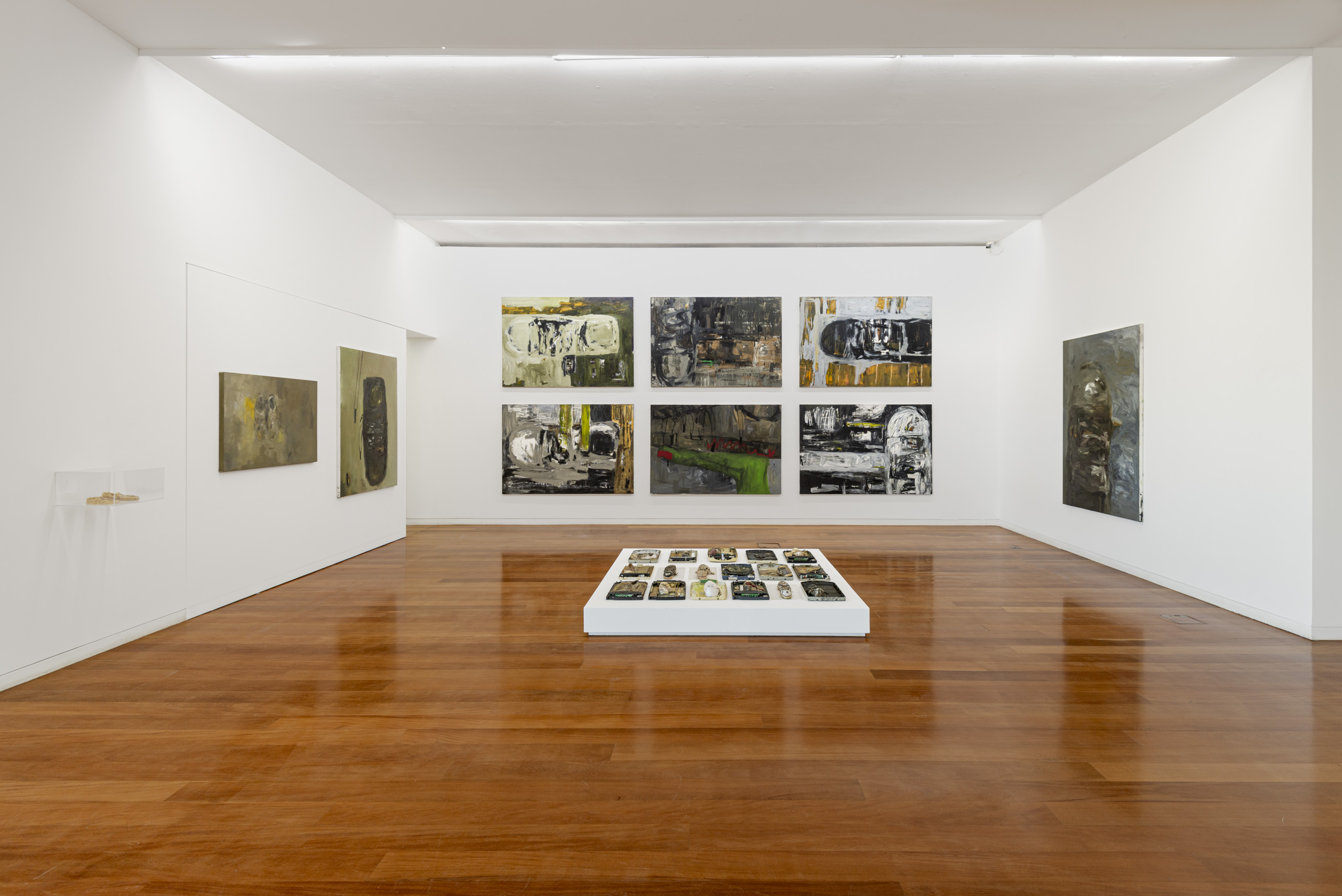
A presente exposição da artista constitui-se de uma seleção de obras que abrange esse período. Balanço reúne, na Fundação Iberê Camargo, cerca de 20 trabalhos produzidos nos últimos 15 anos, depois das primeiras experiências de Maas com a representação de cenas urbanas, entre 2005 e 2009. Dali em diante, a artista assume, de forma resoluta, o espaço da pintura como lugar de tensão, em que se formam unidades problemáticas, vivas e vibrantes. O labor torna-se prioritário em relação ao resultado da obra. Sobre o eventual êxito, prevalece o embate com os instrumentos, as técnicas, as operações e os movimentos do corpo durante a realização, os acidentes e as linguagens pictóricas. E, durante a realização de cada pintura, entram em disputa pensamentos contrários, gestos largos e mínimos, ligeiros e lentos, sujos e minuciosos, entram materiais distintos (a tinta a óleo, o o bastão oleoso, o spray), na obsessiva atividade de colocar, espalhar, raspar e retirar tinta, de pintar, apagar, sujar e pintar de novo, de mexer e mexer, mais uma vez, aqui e ali, em franco vaivém.
No meio de um véu etéreo de cores oníricas, vê-se um cigarro aceso entre o que talvez seja o esboço dos dedos de algo que não chega a ser uma mão, mas próximo de um volume que talvez seja uma cabeça (em Arraia, 2018)… Ou, na silhueta de um corpo humano chapado, formado por manchas e sem carne, vê-se as unhas dos pés pintadas, com capricho, de vermelho (em Pipoca, 2024). Eis dois indicadores de que os extremos importam aqui. Mas, em outros trabalhos, surgem também marcações gráficas, rabiscos, garatujas, hachuras, feitas com bastão oleoso e tinta spray, que flutuam sobre a insinuação de representações, elas mesmas, decompostas, numa dinâmica ininterrupta de integração e desagregação. No mais, embora reconhecer ou não figuras seja parte do jogo na relação do observador com os trabalhos, não é isso, de jeito nenhum, que os define – não são classificações como figuração e abstracionismo, expressividade ou controle, boa ou má pintura. Antes, é interessante notar como a qualidade dubitativa dessa produção acaba por se manifestar com vigor e insolência nos resultados. Movida por incertezas que estão mais próximas da perplexidade do que do titubeio.
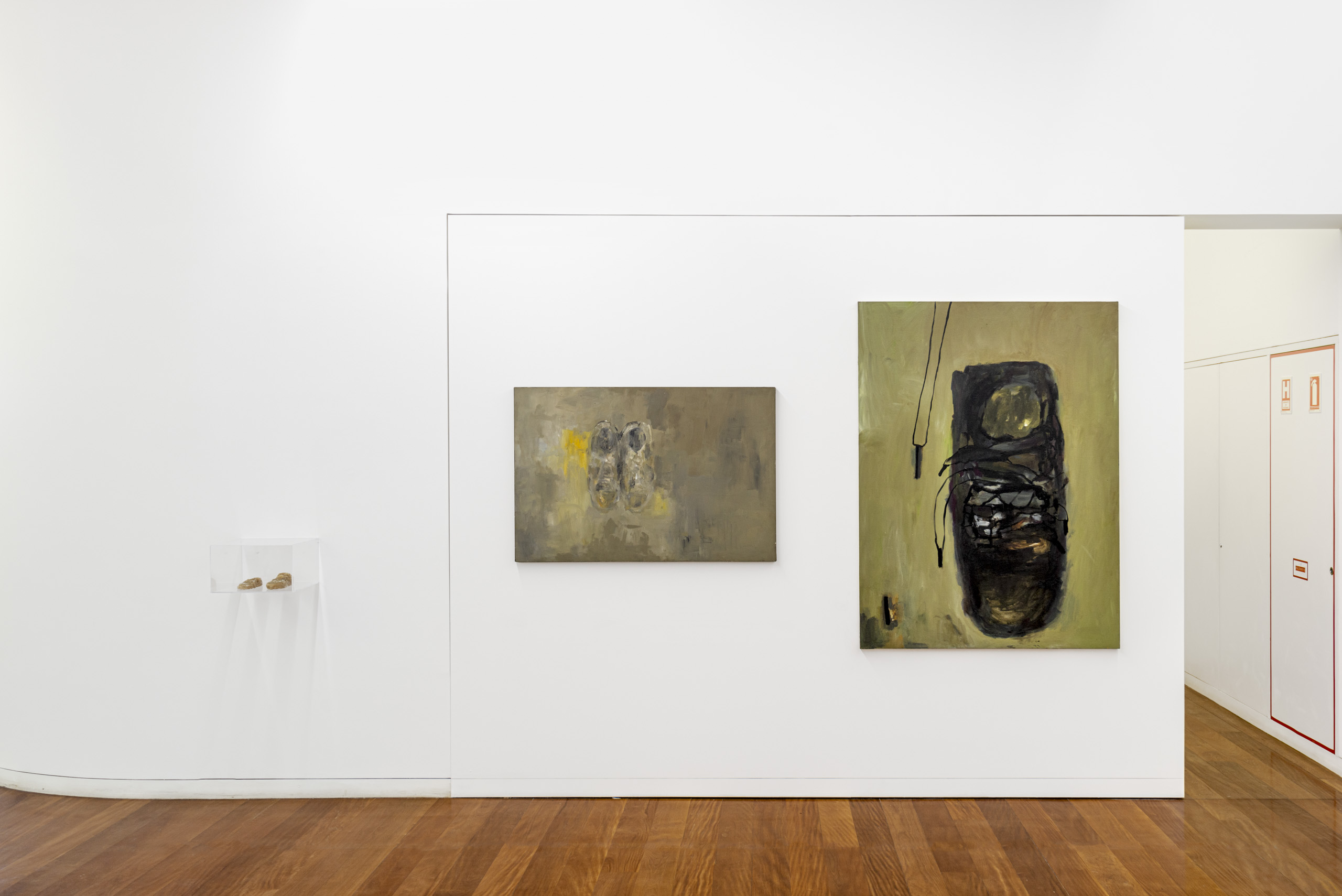
A ênfase nos processos de elaboração se torna evidente, no andamento do trabalho de Luciana Maas, à medida que a artista reitera a opção por pintar somente tênis – ou a partir do “motivo” tênis –, por anos consecutivos, de 2010 a 2015. Sem ocupar-se com a decisão de o quê pintar, mas como. Depois disso, os calçados continuam a aparecer no trabalho, porém, intercalados já com outras ideias. Registre-se que os tênis se tornaram o pretexto para a artista exercer e exercitar a pintura por longo período. E o que particularizaria cada uma de suas obras seriam seus modos de realização e aparecimento. Na prática, o trabalho consistia em dar forma aos tênis, ao mesmo tempo em que os fustigava, com ímpetos variados, ora com uma violência de estraçalhar, ora com o acalento de quem toma ou molda seus objetos com as mãos.
Nessas obras, os calçados são quase sempre vistos de cima para baixo, na maioria das vezes não vestidos, soltos no plano, com um único pé de um par no quadro. Também a paleta de cores é restrita, reduzida ao preto, branco e amarelo, com inserções pontuais de vermelhos, verdes e azuis. Mas, em contraste com esses afunilamentos, as soluções são várias. Há trabalhos gráficos, com traços ligeiros, decididos na observação do objeto e produzidos com tinta preta, que desenham os tênis; há outros com muita matéria, aplicadas em pinceladas enérgicas, que arrastam pela superfície uma tinta espessa, como lama, e se cruzam, no limiar do informe (Tênis respingo, 2012); há telas em que mal se identificam os sapatos nem figura nenhuma (Tênis batom, 2012); assim como há pinturas silenciosas, rebaixadas, em que os calçados, vistos do alto, repousam quase ao centro do quadro, levemente à esquerda, enquanto seus limites se desmancham e se confundem, quase sob fumaça, com o entorno, em imagem acinzentada, com um pouco de amarelo nas laterais dos objetos (Tênis ela, 2010).
De qualquer modo, a escolha dos tênis como “o” motivo de sua pintura indica a procura de Maas por uma materialidade “baixa”, suja, vulgar até. Talvez a sugestão de uma pintura andarilha confirmasse a relevância, para a artista, de fazer a exposição franca, ao observador, dos materiais, procedimentos e, enfim, do curso de realização de seus trabalhos. Simbolicamente, os sapatos acumulariam, na própria constituição física, as marcas do trajeto palmilhado. Mais que isso: os calçados não recolheriam apenas as marcas dos caminhos percorridos, como refletiriam os efeitos desse caminho no corpo e na alma dea quem os calçou. Quanto mais gastos e detonados, maiores teriam sido as dificuldades que enfrentaram. Há, enfim, alto grau de simbolismo e dramaticidade na imagem de calçados gastos, desamarrados e fora dos pés, em nível que talvez possa ser medido peloss debatess travadoss em torno de um dos pares de botas pintados por Vincent Van Gogh, de 1886, a partir de textos de Martin Heidegger, Meyer Schapiro e outros. Na labuta de Luciana Maas, embora a recorrência do motivo não sirva tanto à representação, mas à análise e transfiguração, a repetição parece dizer algo sobre o tempo, sobre as possibilidades de variação e sobre as tentativas insistentes de apanhar algo que, independentemente dos pontos a que se chegue, sempre escapará entre os dedos – por sua qualidade inefável.
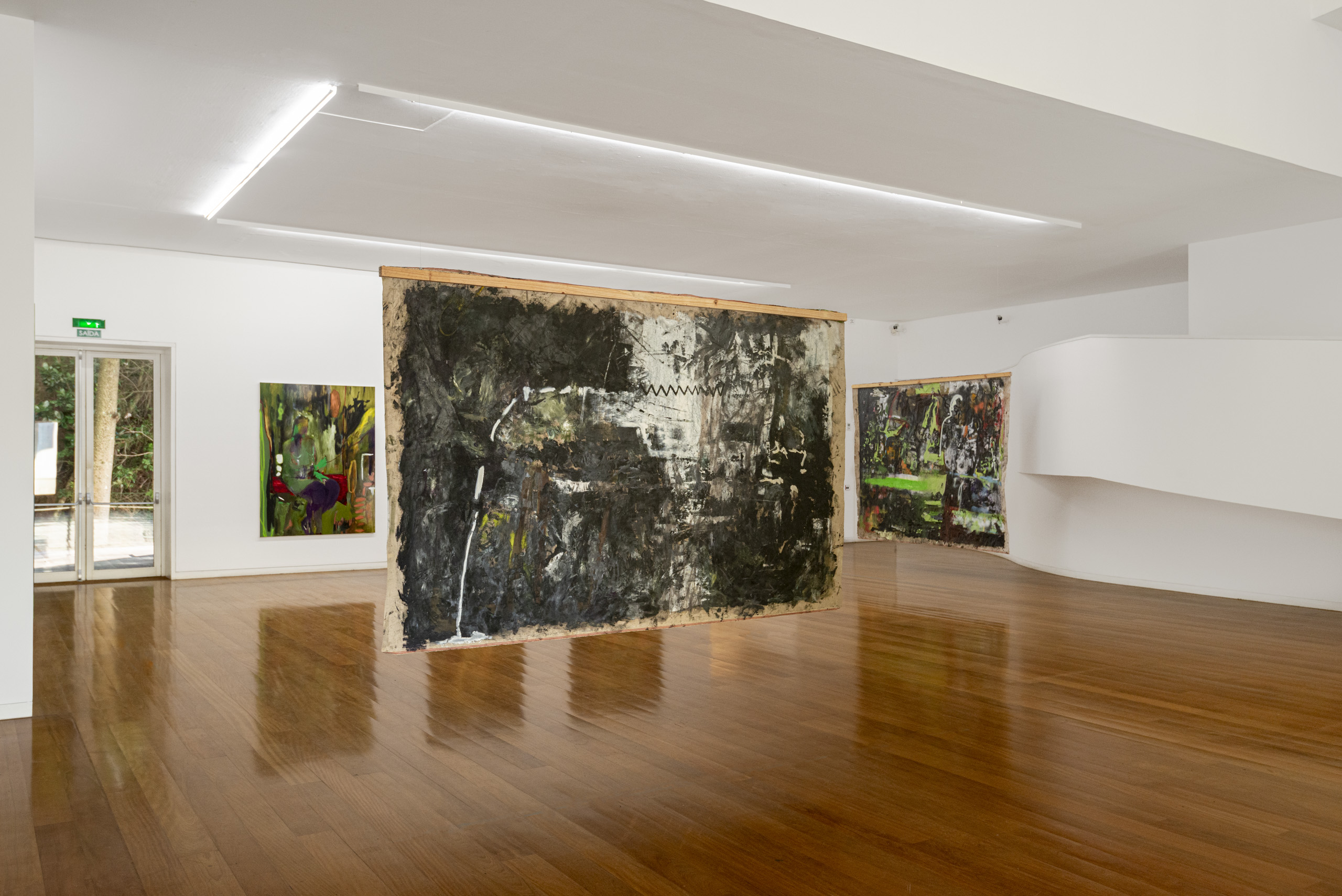
A partir de 2017, Luciana Maas inicia uma produção de pinturas sem tema nem referência prévia. São trabalhos cuja elaboração começava com as mãos em contato direto com a tinta a óleo; com o espalhamento da tinta sobre a superfície, apenas “para sujar a tela”, como a artista descreve. Além disso, o tamanho dos suportes amplia ainda mais a escala de suas obras, que, ademais, sempre fora grande. Assim, trabalhos que mediam, em geral, 130 x 190 cm. saltam para 210 x 270 cm., por exemplo. O ataque de Maas sobre a tela e a tinta também explode, para assumir todas as direções e entornar uma profundidade pantanosa e escura, da qual se sobressaem linhas tracejadas na extensão do plano, em reta, ziguezague, ou como garatujas.
Apesar de o preto prevalecer nesses trabalhos, chama a atenção, retrospectivamente, a inserção de outras cores, como os vermelhos e verdes, sempre de maneira desregrada, sem restrições ou limitações aparentes. É também nesta passagem de sua trajetória que Luciana Maas começa a incorporar a tinta spray em suas pinturas. De início, o spray contrasta com a tinta a óleo pelas linhas chapadas de cor que se estendem, em primeiríssimo plano, por cima da mistura viscosa e escura que encobre a tela. Ao mesmo tempo, esses rabiscos têm uma indeterminação nas laterais, decorrente do espargimento e da pulverização da tinta, que interrompe e corta a massa pictórica, por meio de uma luminescência muito artificial, expansiva, elétrica mesmo, em efeito contrário ao previsto para seu uso profissional, destinado a acabamentos uniformes e suaves. Nessas pinturas, o spray acende e interrompe outros fluxos. Também a desenvoltura e a liberdade que a produção da artista adquire dali em diante é notável. Dois trabalhos presentes nesta exposição são demonstrativos disso: Cachoeira preta (2017) e Bisonte (2018), cujos títulos surgem de elementos que a artista afirma vislumbrar nos resultados, embora não haja ali, naquelas amarrações instáveis, repouso nenhum para a visão.
Quando realiza a mostra Palafitas, em 2022, Maas apresenta um grupo significativo de pinturas em que, pela primeira vez em sua trajetória, a silhueta ou o esboço de figuras humanas organiza a experiência da visão. São figuras que tomam o centro do quadro, de alto a baixo, em posições por vezes eróticas e, em sua maioria, com membros amputados. São estruturas físicas tronchas, mutiladas, que irradiam eletricidade. Inspiram violência e energia, como a própria pintura que as constitui. Em alguns desses trabalhos, os corpos dos personagens constituem-se disso mesmo, somente cor e luz. Decepados ou não, são cromaticamente homogêneos. E nessas obras há distinção marcada, com alto contraste de cor, entre figura e fundo (por exemplo, em Pão, de 2021, Sob fios e Correntes de luz, ambas de 2020).
Noutros trabalhos daquela exposição, as figuras se insinuam aos fragmentos, retalhadas em meio a um nevoeiro de gases coloridos. São seres dilacerados, desfiados, atravessados e/ou que se deixam contaminar pelo espaço, até que não haja distinção entre corpo e entorno, numa espécie de continuidade sem limites. A obra que dá título àquela mostra, Palafitas, presente aqui na Fundação Iberê, produz uma imagem forte e emblemática desse aspecto fantasmagórico que a obra de Luciana Maas continua a apresentar desde então. Nessa pintura, quatro desses corpos – ou visões – apoiam-se, de pé, sobre estacas. À exceção do volume da esquerda, feito com tinta branca e parcialmente pintado com verde e, em parte do contorno, com vermelho, os demais são “lambidos”, ou tragados, pela mesma matéria viscosa do fundo. Não há indício de fogo na imagem, e mesmo assim esses personagens parecem absorvidos por chamas escuras, talvez de uma noite quente a queimar na pele. Tampouco a pintura inspira algo religioso; e, no entanto, há qualquer coisa evocativa da gólgota de Cristo. Uma cena monstruosa, com dor evidente, porém, sem afetações sentimentalistas.
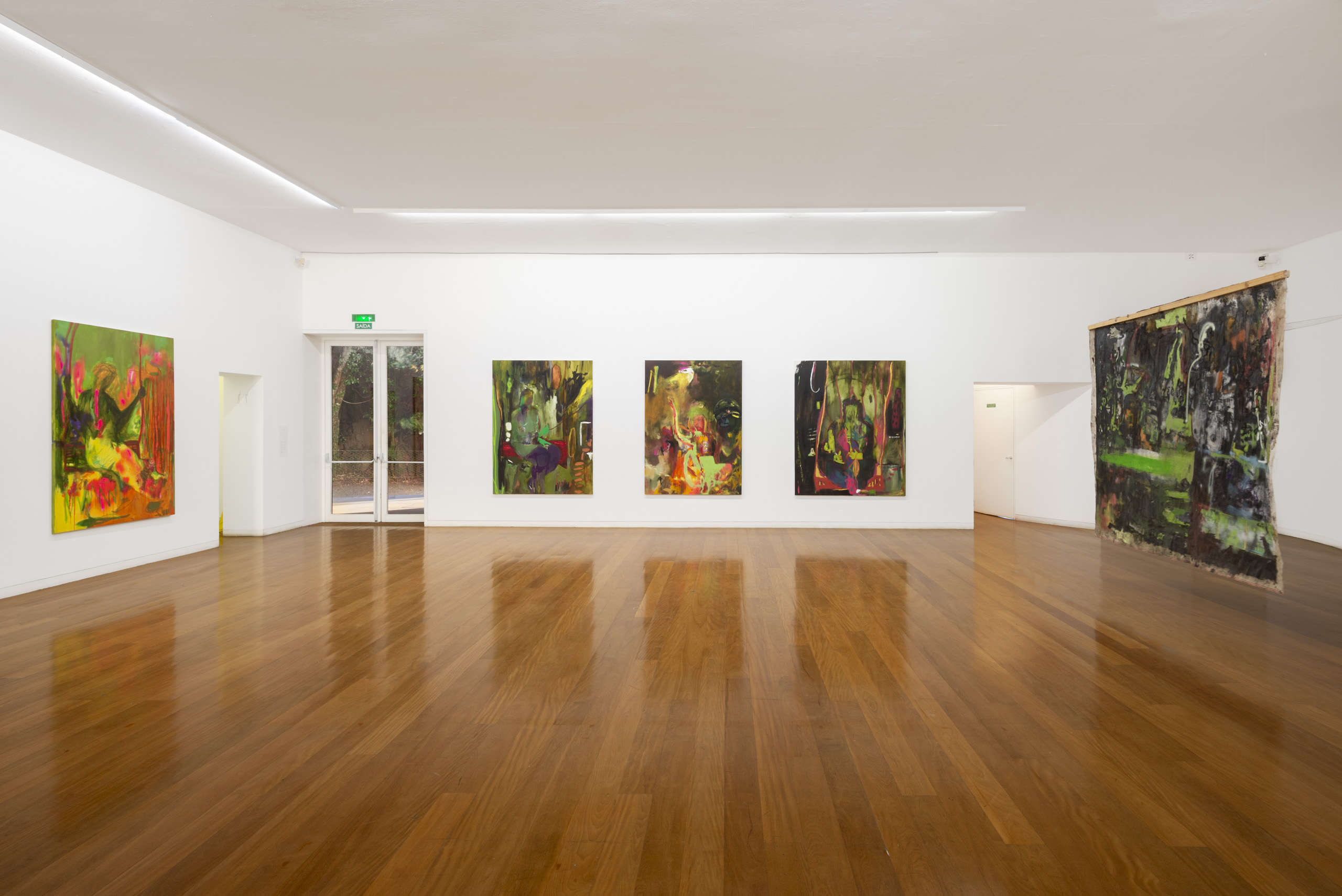
Os aspectos ácido e assombroso que a pintura da artista adquire em 2020 – com cores fluorescentes, de alta estridência, azedas e corrosivas até para os olhos – se intensificam em trabalhos recentes. As passagens cromáticas se dão de maneira mais direta, com desenhos e cores autônomos em relação uns aos outros e sem que nem aqueles nem estas assumam o compromisso de fechar seres, objetos, espaço, contribuindo para a insinuação de uma espécie de cena psicológica. Assim, nos corpos, ou nos fragmentos de corpos humanos, já não há sequer a unidade cromática daqueles personagens anteriores. Estes são descarnados, invertebrados, fragmentários…
Aliás, em algumas dessas pinturas produzidas por Maas nos últimos dois anos, há uma fúria jamais vista na produção. Uma ira que se anuncia, nos trabalhos, em áreas marcadas por golpes largos, rápidos e, na aparência, raivosos; por pinceladas e raspagens, pelo uso do verso do pincel para produzir ranhuras, por atitudes de quem talvez tentasse abrir fendas naquela superfície, rasgá-la, para inspecionar o que haveria ali dentro ou o que mais poderia sair dali. A artista reitera, nesses trabalhos, a desobediência em relação às proporções harmoniosas da anatomia. Também por isso, esses corpos se parecem com plasmas, com a visão de espectros, em expansão ou retração, sem contornos definidos.
Na esteira desses gestos de corte, caem do alto das pinturas recentes grupos de linhas que ou restam pendentes ou sustentam balanços em que se sentam figuras humanas. Esses elementos – disformes, instáveis visualmente – aparecem em enquadramentos que o cinema convencionou chamar de americano. Já a disposição de seus corpos – que, mais uma vez, ocupam o quadro de cima a baixo – remete a uma linhagem particular de pinturas com personagens sentados; linhagem que remonta a Diego Velázquez (em particular, ao Retrato de Inocêncio X, c. 1650); passa por Goya, inclusive por conta daqueles fundos escuros que não delimitam um ambiente, se não uma atmosfera; passa pelas figuras estáticas e imageticamente irrequietas dos retratos de Alberto Giacometti; passa por Francis Bacon, que, em 1953, produziu seu Estudo para um retrato do Papa Inocêncio X de Velázquez; e chega a uma parte da obra final de Iberê Camargo, que nomeou como “idiotas” suas criaturas descarnadas e assexuadas de pinturas (como As idiotas e Tudo te é falso e inútil), realizadas entre 1991 e 1993.
Desse agrupamento ligeiro de obras e artistas tão diversos desprendem-se, por sua vez, ideias de distanciamento, de ambientes penumbrosos, gestos de dilaceramento, a sugestão de sentimentos de dor e desaparecimento… Enfim, um estado de coisas que tem conexão com aquilo que informa a obra de Luciana Maas. De par com essa natureza trágica, sinistra, a produção da artista divide, ainda, com obras pictóricas de Giacometti e Iberê uma entrega frenética à ação. E, sem dúvida, essas estão entre as características que singularizam a obra de Maas no panorama recente da arte: a pintura de ação, caracterizada por sua autoafirmação contínua, e o interesse por cenas basculantes, entre o torpor e a iminência de um desastre.
Mais comum, hoje, é deparar com trabalhos que lidam com a pintura de maneira supostamente leve e descompromissada. A fim de instituir uma espécie de grau zero da linguagem, ou de armar abordagens cômicas, irônicas, ou cínicas mesmo dos problemas da imagem na vida contemporânea – entre eles, o de sua fugacidade; como se essas alternativas servissem de antídoto ao peso e ao ranço de tradições pictóricas, a serem, em geral, lembradas, satirizadas e contornadas, ao mesmo tempo. Daí a aparência ilustrada, em misto de graça e frescor, como se não se aderissem a posição ideológica nenhuma, com que muitos se apresentam.
De sua parte, a pintura de Luciana Maas evoca as condições da existência humana, sem gravidade nem grandiloquência. Sem fazê-lo para a afirmação de uma subjetividade que se julgaria privilegiada, de uma expressividade heroica, espontânea ou, ao contrário, atravessada tão somente de angústia; mas na inspeção crítica de suas possibilidades de agir no presente. O trabalho da artista é rasteiro, mundano e meditativo a respeito dos prazeres, dos horrores e da finitude da vida. Parece, nesse sentido, enfrentar aquilo que se encontra desgastado como matéria da arte contemporânea, para levar adiante um trabalho avesso a fixações e estabilidades. A fim de manter-se, com isso, tentativo, em suspensão e balanço.
The Poverty of the Self
The Opulence of the World.
The Opulence of the Self
The Poverty of the World.
The Poverty of Everything
The Opulence of Everything.
The Uncertainty of Everything
In the Certainty of Nothing.
Carlos Drummond de Andrade
Making implies destruction – and therefore contradiction – in Luciana Maas’s work processes. Her paintings express this negativity through a remarkable refusal to fix and stabilize the structures she builds. For this reason, what her canvases show is more like a precipitation, an abrupt cut-off, than an outcome or a resolved conclusion to her operations. The incongruity of disjointed procedures, which go in different and sometimes divergent directions on the same plane, favors this inconclusive character, of things that don’t fit together. And they really don’t. This does not mean, however, that the works appear incomplete or interrupted. The works are complete, loaded, dense. They result in surfaces filled with overlapping and more overlapping matter and activity.
Another apparent paradox has to do precisely with the fact that paintings so impregnated with substance and action are populated by discarnate, mutilated bodies, by objects in dismantling, stuffed into uncertain spaces, surrounded by fluorescent lights, clouds of smoke and gas – which, judging by their brightness and colors, are radioactive. Now, if the works still inspire unfinishedness, it’s because, once finished, they are still as if they were open-ended, with their events in continuous march, of formation, distortion, crumbling and construction, again, of their parts, in a different way each time, with each examination – especially in the canvases that the artist painted since 2012.
The artist’s current exhibition consists of a selection of works covering this period. Balanço brings together, at the Iberê Foundation, around 20 works produced over the last 15 years, after Maas’ first experiments with depicting urban scenes, between 2005 and 2009. From then on, the artist resolutely took on the space of painting as a place of tension, where problematic, lively and vibrant units are formed. The work becomes a priority in relation to the result of the work. The clash with the instruments, the techniques, the operations and movements of the body during the making, the accidents and the pictorial languages take precedence over the eventual success. And during the making of each painting, opposing thoughts come into dispute, gestures that are both large and small, both light and slow, both dirty and meticulous, different materials come into play (oil paint, oily stick, spray), in the obsessive activity of placing, spreading, scraping and removing paint, of painting, erasing, getting dirty and painting again, of moving and moving, again and again, here and there, back and forth.
Amidst an ethereal veil of dreamlike colors, you can see a lit cigarette between what may be the outline of the fingers of something that isn’t really a hand, but is close to a volume that may be a head (in Arraia, 2018). Or, in the silhouette of a flattened human body, made up of stains and no flesh, you can see toenails painted a fanciful red (in Popcorn, 2024). These are two indicators that extremes matter here. But in other works, there are also graphic markings, doodles, scribbles, hatches, made with both oily stick and spray paint, which float over the insinuation of representations that are themselves decomposed, in an uninterrupted dynamic of integration and disintegration. What’s more, although recognizing or not recognizing figures is part of the game in the viewer’s relationship with the works, this is by no means what defines them – they are not classifications such as figuration and abstractionism, expressiveness or control, good or bad painting. Rather, it is interesting to note how the dubitative quality of this production ends up manifesting itself with vigor and insolence in the results. It is driven by uncertainties that are closer to perplexity than to hesitation.
The emphasis on elaboration processes becomes evident in the progress of Luciana Maas’s work as the artist reiterates her choice to paint only sneakers – or from the “motif” of sneakers – for consecutive years, from 2010 to 2015. Without worrying about what to paint, but how. After that, shoes continued to appear in the work, but interspersed with other ideas. It should be noted that sneakers became the pretext for the artist to practice and exercise painting for a long time. And what made each of her works unique was the way they were made and appeared. In practice, the work consisted of giving shape to the sneakers, at the same time as she beat them, with varying impetus, sometimes with a violence that would tear them apart, sometimes with the warmth of someone who takes or shapes their objects with their hands.
In these works, the shoes are almost always seen from top to bottom, mostly unclothed, loose on the plane, with a single foot of a pair in the picture. The color palette is also restricted, reduced to black, white and yellow, with occasional insertions of reds, greens and blues. But in contrast to these narrowings, there are many solutions. There are graphic works, with light strokes, decided by observing the object and produced with black paint, which draw the sneakers; there are others with a lot of material, applied in energetic brushstrokes, which drag a thick paint across the surface, like mud, and cross each other, on the edge of the shapeless (Tênis Respingo, 2012); there are canvases in which you can barely make out the shoes or any figure (Tênis Batom, 2012); just as there are silent, lowered paintings in which the shoes, seen from above, rest almost in the center of the painting, slightly to the left, while their boundaries fall apart and blur, almost under smoke, with the surroundings, in a greyish image, with a little yellow on the sides of the objects (Tênis Ela, 2010).
Anyway, the choice of sneakers as “the” theme of her painting indicates Maas’s search for a “low”, dirty, even vulgar materiality. Perhaps the suggestion of a walking painting confirms the importance for the artist of openly exposing her materials, procedures and, in short, the course of her work to the observer. Symbolically, the shoes would accumulate, in their own physical constitution, the marks of the path walked. More than that: the shoes would not only collect the marks of the paths traveled, but would also reflect the effects of that path on the body and soul of those who wore them. The more worn and worn out they were, the greater the difficulties they faced. place around one of the pairs of boots that Vincent Van Gogh painted in 1886, based on texts by Martin Heidegger, Meyer Schapiro and others. In Luciana Maas’s work, although the recurrence of the subject is not so much for representation as for analysis and transfiguration, the repetition seems to say something about time, about the possibilities of variation and about the insistent attempts to catch something that, regardless of the points reached, will always slip through the fingers – due to its ineffable quality.
From 2017 onwards, Luciana Maas began producing paintings without any previous theme or reference. Those works began with her hands in direct contact with the oil paint, spreading it over the surface, just “to get the canvas dirty”, as she describes it. In addition, the size of the supports further expands the scale of her works, which had always been large. Thus, works that often measure 130 x 190 cm jump to 210 x 270 cm, for example. Her attack on the canvas and the paint also explodes, taking on all directions and spilling into a swampy, dark depth, from which dashed lines stand out across the expanse of the plane, straight, zigzagging or as scribbles.
Even though black prevails in these works, retrospectively, the insertion of other colors, such as reds and greens, always in an unrestrained way, without apparent restrictions or limitations, is striking. It was also at this point in her career that Luciana Maas began to add spray paint to her paintings. At first, the spray contrasts with the oil paint due to the flat lines of color that extend, in the foreground, over the dark, viscous mixture that covers the canvas. At the same time, these squiggles have an indeterminacy on the sides, due to the spreading and spraying of the paint, which interrupts and cuts through the pictorial mass, by means of a very artificial, expansive, electric luminescence, in an effect contrary to that intended for its professional use, intended for uniform and smooth finishes. In these paintings, the spray ignites and interrupts other flows. The resourcefulness and freedom that the artist’s production acquires from then on is also remarkable. Two works in this exhibition demonstrate this: Cachoeira Preta (2017) and Bisonte (2018), whose titles come from elements that the artist claims to glimpse in the results, although there is no rest for the eye in those unstable connections.
When she held the Palafitas exhibition in 2022, Maas presented a significant group of paintings in which, for the first time in her career, the silhouette or outline of human figures organized the experience of vision. They are figures that take up the center of the painting, from top to bottom, in sometimes erotic positions and mostly with amputated limbs. They are stumpy, mutilated physical structures that radiate electricity. They inspire violence and energy, just like the painting itself. In some of these works, the characters’ bodies are just that, only color and light. Whether severed or not, they are chromatically homogeneous. And in these works there is a marked distinction, with high color contrast, between figure and background (for example, in Pão, from 2021, as well as in Sob Fios and Correntes de Luz, both from 2020).
In other works from that exhibition, the figures insinuate themselves into the fragments, shredded amid a fog of colored gases. They are beings that are torn, shredded, pierced or that allow themselves to be contaminated by space, until there is no distinction between body and surroundings, in a kind of limitless continuity. The work that gave that show its title, Palafitas, on display here at the Iberê Foundation, produces a strong and emblematic image of this ghostly aspect that Luciana Maas’s work has continued to present ever since. In that painting, four of those bodies – or visions – stand on stilts. With the exception of the volume on the left, made with white paint and partially painted with green and, in part of the outline, red, the others are “licked”, or swallowed, by the same viscous matter as the background. There is no hint of fire in the image, and yet these characters seem absorbed by dark flames, perhaps from a hot night burning their skin. Nor does the painting inspire anything religious; and yet there is something evocative of Christ’s Golgotha. A monstrous scene, with obvious pain, but without sentimental affectations.
The acidic and haunting aspects that the Luciana’s paintings acquired in 2020 – with fluorescent colors, high stridency, sour and corrosive even to the eyes – have intensified in recent works. The chromatic passages are more direct, with drawings and colors that are autonomous in relation to each other and without either of them assuming the commitment to close off beings, objects or space, contributing to the insinuation of a kind of psychological scene. Thus, in the bodies, or fragments of human bodies, there is no longer even the chromatic unity of those previous characters. They are discarnate, invertebrate, fragmentary…
In fact, in some of these paintings that Maas has produced over the last two years, there is a fury that has never been seen before. An anger that announces itself, in the works, in areas marked by broad, quick and, in appearance, angry strokes; by brushstrokes and scrapes, by the use of the back of the brush to produce grooves, by attitudes of someone who might try to open cracks in that surface, to tear it apart, to inspect what would be inside or what else might come out of it. In these works, the artist reiterates her disobedience to the harmonious proportions of anatomy. This is also why these bodies look like plasmas, like the vision of spectres, expanding or shrinking, without defined contours.
In the wake of these cutting gestures, groups of lines fall from the top of recent paintings, either hanging down or supporting swings on which human figures sit. These elements – shapeless, visually unstable – appear in frames that cinema has come to call American. The disposition of their bodies – which, once again, occupy the picture from top to bottom – refers to a particular lineage of paintings with seated characters; a lineage that goes back to Diego Velázquez (in particular, the Portrait of Innocent X, c. 1650); passes through Goya. 1650); it goes through Goya, not least because of those dark backgrounds that don’t delimit an environment, if not an atmosphere; it goes through the static and imagistically restless figures of Alberto Giacometti’s Francis Bacon, who, in 1953, produced his Study for a portrait of Pope Innocent X by Velázquez; and arrives at part of the final work of Iberê Camargo, who named his disembodied and asexual creatures in paintings (such as As Idiotas and Tudo Te é Falso e Inútil), made between 1991 and 1993, “idiots”.
In turn, From this light grouping of such diverse works and artists, there’s a release, , ideas of detachment, of gloomy atmospheres, gestures of tearing apart, the suggestion of feelings of pain and disappearance… In short, a state of affairs that has a connection with what informs Luciana Maas’ work. Alongside this tragic, sinister nature, the artist’s production also shares with pictorial works by Giacometti and Iberê a frenetic commitment to action. And, without a doubt, these are among the characteristics that distinguish Maas’s work in the recent art scene: action painting, characterized by its ongoing self-affirmation, and the interest in tilting scenes, between torpor and the imminence of a disaster.
It is more common today to come across works that deal with painting in a supposedly light and uncompromising way. In order to establish a kind of zero degree of language, or to set up comic, ironic or even cynical approaches to the problems of the image in contemporary life – among them, its fleetingness; as if these alternatives served as an antidote to the weight and rancidity of pictorial traditions, which are often remembered, satirized and circumvented at the same time. Hence the illustrated appearance, in a mixture of grace and freshness, as if they didn’t adhere to any ideological position, which many of them do.
As for Luciana Maas’s painting, it evokes the conditions of human existence without severity or grandiloquence. Without doing so in order to affirm a subjectivity that would be considered privileged, of a heroic, spontaneous expressiveness or, on the contrary, one crossed only by anguish; but in the critical inspection of its possibilities of acting in the present. The artist’s work is mundane and meditative about the pleasures, horrors and finitude of life. In this sense, she seems to be confronting what has been worn out as the material of contemporary art, in order to carry out a work that is averse to fixation and stability. In order to remain tentative, in both suspension and balance.
José Augusto Ribeiro
José Augusto Pereira Ribeiro holds a master’s degree and a PhD in Art Theory, History and Criticism from the School of Communications and Arts at the University of São Paulo. He worked as senior curator at Pinacoteca de São Paulo from 2012 to 2022 and director of the visual arts center at Centro Cultural São Paulo between 2010 and 2012.



Exposições / Exhibitions
-
Bicho Solto
Luciana Maas
solo show
exposição individual
-
Palafitas
Luciana Maas
solo show
exposição individual
-
Comme il Faut
collective show
exposição coletiva