Bicho Solto
Luciana Maas – Bicho Solto
Ricardo Sardenberg
“Em vez de uma hermenêutica, precisamos de uma erótica da arte.”
— Susan Sontag, Against Interpretation
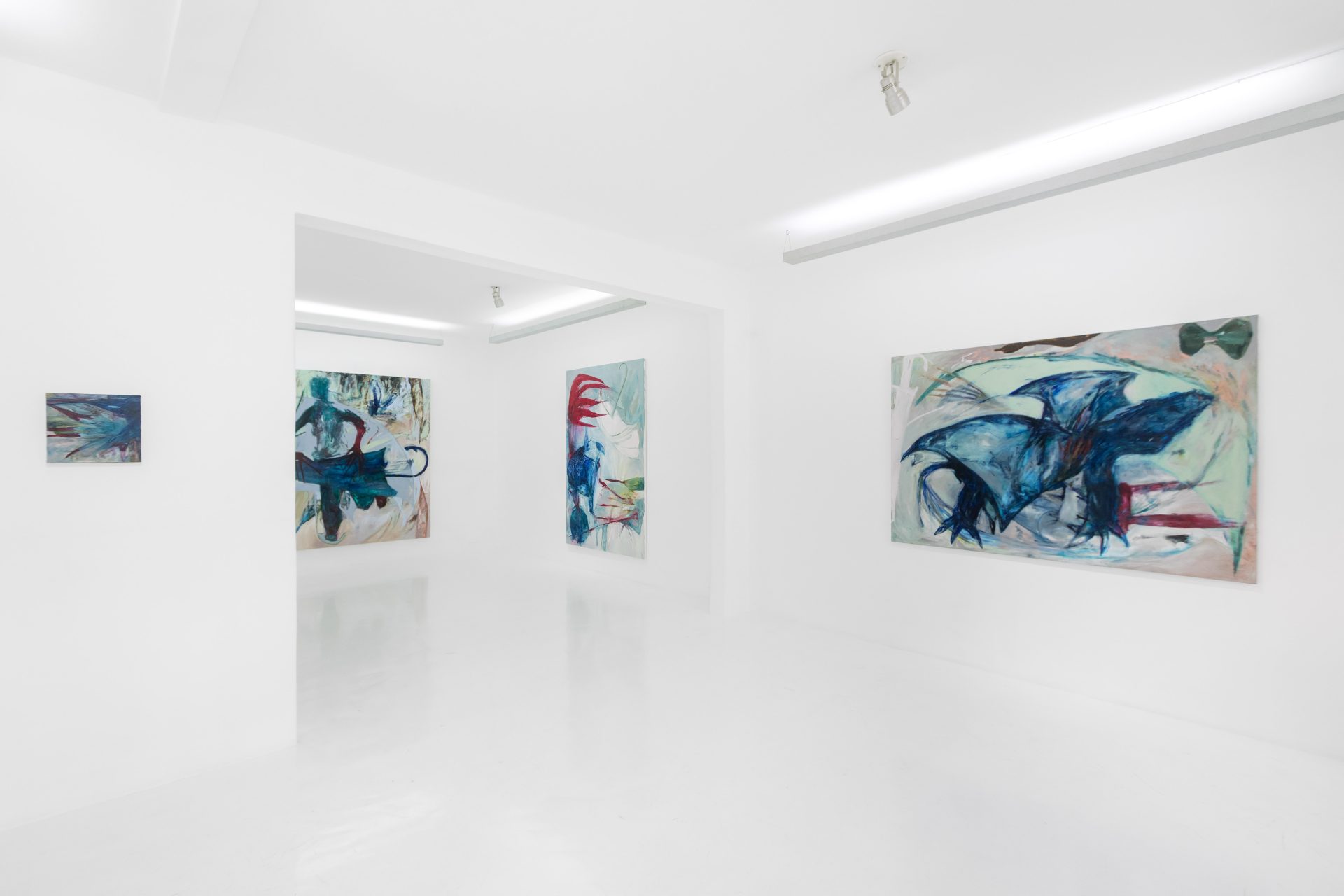
Na contramão da nitidez e da eficiência que regem o regime visual contemporâneo, a pintura de Luciana Maas insiste no opaco, no precário, no irresoluto. Suas telas não oferecem respostas, mas embates. Cada superfície é um campo de tensão, onde a imagem não se afirma — ela sobrevive. Em vez de representar o mundo, a pintura de Maas o enfrenta: como quem tenta formar algo no escuro, entre camadas de tempo, corpo e matéria.
Hoje somos saturados por imagens nítidas, sedutoras, eficientes. Mas Luciana nos devolve o que é opaco, precário, inacabado. Ela nos convida a habitar o intervalo entre o ver e o saber, entre o gesto e o sentido. Resiste a todo tipo de interpretação simples, do tipo que tenta desvendar o “significado” do trabalho.
Ao contrário: ela nos confronta com a presença do trabalho — esse espaço físico entre o nosso corpo e a obra na parede. E é nesse intervalo que sua pintura nos convoca — não como espectadores passivos, mas como participantes de um acontecimento sensível, em que a matéria, o corpo e o tempo se entrelaçam sem jamais se resolverem. Será que isso não é uma representação do mundo atual, que deseja diariamente a destruição total, o apagamento?
Na pintura de Luciana Maas, não é a imagem que se impõe — é a experiência do pintar. Diante de suas telas, o olhar não encontra um motivo pronto, uma cena ilustrada, uma história a ser contada ou um slogan político a ser seguido, mas uma superfície em estado permanente de luta inacabada.
É ali, naquele campo instável, que algo acontece: a tinta não serve à figura, ao conteúdo, nem a um desejo de abstração. A pintura está em constante disputa com esse binômio clássico entre figura e abstração e, a partir dele, reivindica sua própria existência. Cada decisão pictórica carrega em si a hipótese de sua revogação.
Trata-se menos de uma composição do que de uma arqueologia negativa, onde o que vemos é a sedimentação de um tempo não linear — um tempo do trauma, do colapso e da persistência residual. É matéria que insiste, que recobre, que nega. É corpo. E, como tal, age.
A tela não é suporte de uma representação: é lugar de fricção entre gesto e resistência, entre o que quer surgir e o que insiste em se apagar. A matéria pictórica — densa, acumulada, às vezes raspada — não ilustra, mas atua. Ela cria zonas de tensão onde o visível não é dado, mas construído a duras penas.
Quando finalmente a forma surge, ela não se estabiliza numa narrativa. Ela paira. Sem explicações. Guarda-chuvas, silhuetas, animais talvez — são presenças espectrais, fantasmagóricas. Não porque remetam a um mundo próprio, mas porque não se deixam fixar.
São sobreviventes, como todos nós somos, todo dia de manhã, quando acordamos para a vida — ao embate com a própria pintura, aquela que nos quer apagar.
Esse embate não é metafórico: é físico. Ele sugere uma relação tátil, carnal, vulnerável com o objeto artístico. É na relação entre corpo, gesto e superfície que se dá o acontecimento da obra.
Maas não busca “expressar” um conteúdo interior, nem da sua subjetividade, nem de sua biografia — ela se lança no processo da pintura como quem investiga, tateia, hesita diante do acontecimento de pintar.
Sua prática se estrutura a partir de interrupções sustentadas, zonas de indecisão onde o tempo do fazer fica impresso como memória encarnada na matéria. A tinta não é meio, mas fim: aquilo com que — e, ao mesmo tempo, contra o que — se luta.
A figura — fantasmagórica, vacilante — não se impõe sobre o fundo, porque não há fundo. Há campo. E, nesse campo, a imagem não se apresenta como conquista, mas como resto. Resto do que tentou se formar e não conseguiu inteiramente.
Ela sobrevive ao processo da fatura. É o que resta de uma tentativa que fracassa continuamente e que, nesse fracasso, recusa a lógica da eficiência e da resolução.
Sua presença espectral desnaturaliza o olhar do espectador, convocando-o a habitar uma zona de irresolução — o que, em si, já é um contrassenso artístico num tempo marcado pela hiperprodutividade da imagem.
“In place of a hermeneutics we need an erotics of art”
— Susan Sontag, Against Interpretation
Contrary to the sharpness and efficiency that govern the contemporary visual regime, Luciana Maas’s painting insists on the opaque, the precarious, the irresolute. Her canvases do not offer answers, but clashes. Each surface is a field of tension, where the image does not assert itself — it survives. Instead of representing the world, Maas’s painting confronts it: like someone trying to form something in the dark, between layers of time, body, and matter.
Today we are saturated with sharp, seductive, efficient images. But Luciana gives us back what is opaque, precarious, unfinished. She invites us to inhabit the gap between seeing and knowing, between gesture and meaning. She resists any kind of simplistic interpretation — the kind that tries to uncover the “meaning” of the work.
On the contrary: she confronts us with the presence of the work — that physical space between our body and the painting on the wall. And it is in this interval that her work calls us — not as passive spectators, but as participants in a sensitive event, where matter, body, and time intertwine without ever resolving. Isn’t this a representation of the contemporary world, which craves total destruction or erasure on a daily basis?
In Luciana Maas’s painting, it is not the image that imposes itself — it is the experience of painting. Before her canvases, the viewer’s eye does not encounter a ready-made motif, an illustrated scene, a story to be told, or a political slogan to be followed, but a surface in a permanent state of unfinished struggle.
It is there, in that unstable field, that something happens: the paint does not serve the figure, the content, nor a desire for abstraction. The painting constantly wrestles with this classical duality between figure and abstraction and, from it, asserts its own existence. Each pictorial decision carries within it the possibility of being revoked.
It is less a composition than a negative archaeology, where what we see is the sedimentation of a non-linear time — a time of trauma, collapse, and residual persistence. It is matter that insists, that covers, that denies. It is a body. And as such, it acts.
The canvas is not a support for representation: it is a site of friction between gesture and resistance, between what wants to emerge and what insists on disappearing. The pictorial matter — dense, layered, sometimes scraped — does not illustrate, but acts. It creates zones of tension where the visible is not given but laboriously constructed.
When form finally emerges, it does not settle into narrative. It hovers. Without explanation. Umbrellas, silhouettes, animals perhaps — these are spectral, ghost-like presences. Not because they refer to a world of their own, but because they refuse to be fixed.
They are survivors, as we all are, every morning when we wake up to life — to the confrontation with painting itself, the one that wants to erase us.
This confrontation is not metaphorical: it is physical. It suggests a tactile, carnal, vulnerable relationship with the artistic object. It is in the relationship between body, gesture, and surface that the event of the artwork takes place.
Maas does not seek to “express” inner content — neither her subjectivity nor her biography. She throws herself into the process of painting like someone who investigates, gropes, hesitates before the act of painting.
Her practice is structured around sustained interruptions, zones of indecision where the time of making is imprinted as memory embodied in matter. Paint is not a means, but an end: that with which — and against which — one struggles.
The figure — ghostly, wavering — does not impose itself on the background, because there is no background. There is a field. And in that field, the image is not presented as a conquest, but as a remainder. A remainder of what tried to take form and could not fully succeed.
It survives the process of making. It is what remains of a continuous failure — and in that failure, it refuses the logic of efficiency and resolution.
Its spectral presence denaturalizes the viewer’s gaze, calling them to inhabit a zone of irresolution — which, in itself, is already an artistic contradiction in a time dominated by the hyperproductivity of the image.




Exposições / Exhibitions
-
Balanço
Luciana Maas
solo show
exposição individual
-
Palafitas
Luciana Maas
solo show
exposição individual
-
Comme il Faut
collective show
exposição coletiva