Problema Meu
Problema Meu
Ricardo Sardenberg
Muito se fala hoje da imagem digital e das redes sociais como dispositivos de fabricação da identidade — como se a subjetividade contemporânea estivesse confinada às telas.
Mas o regime das imagens é muito mais vasto e difuso. Ele atravessa objetos banais, superfícies descartáveis e pequenos artefatos do cotidiano que, silenciosamente, constituem uma economia paralela de signos.
Isqueiros, cigarros, estampas de camisetas, bonés, cartões e papéis soltos — todo esse lixo cultural, rapidamente produzido e descartado — constitui, na verdade, um dos laboratórios mais eficazes da sensibilidade contemporânea.
É nesse campo aparentemente trivial que Felipe Barsuglia opera.
O artista produz imagens a partir do que recolhe de resíduos, trabalhando sobre o detrito simbólico que resta após o consumo.
Seu gesto consiste em deslocar esses objetos para um regime estético onde deixam de ser utilitários e passam a revelar a lógica que os sustenta: a circulação infinita de signos, sem origem nem destino, mas que, nesse processo, afetam a própria subjetividade.
Por isso, Barsuglia realiza essa operação não como resolução, mas como problema.
Em Problema Meu, sua terceira exposição individual na galeria Sardenberg, o artista parte de uma evidência aparentemente banal: todos têm problemas.
A frase, repetida até a exaustão no cotidiano, transforma-se aqui em uma espécie de unidade mínima da experiência contemporânea — um signo universal, tão genérico que já não pertence a ninguém em particular.
Afinal, todos nós temos problemas.
A exposição se inicia com Problemas, um vídeo em loop.
Nele, uma figura animada atravessa uma sequência de pequenos acidentes: uma pedra no caminho, um tropeço, uma queda descontrolada, até finalmente “entrar pelo cano”.
A narrativa da falha é acompanhada por uma trilha sonora igualmente absurda: aplausos de uma plateia invisível.
O fracasso torna-se espetáculo.
A queda transforma-se em performance.
O erro é celebrado como se fosse um triunfo — ou talvez já não exista diferença entre ambos.
Na mesma sala encontra-se Ailgusrab 2.
Um par de tênis velhos, amarrados pelo cadarço, está pendurado na tesoura de madeira que sustenta o telhado.
Na sola está escrito ailgusrab, anagrama do sobrenome do artista invertido.
O nome aparece em uma série de vídeos em que celebridades, protocelebridades, amigos e pessoas que o artista ama e admira repetem essa palavra sem sentido em um loop mecânico, como se respondessem a uma entrevista.
Quando reproduzido ao contrário, o nonsense revela o nome do artista.
A linguagem aqui já não comunica.
Ela se dobra sobre si mesma, circula em inversão temporal e transforma-se em puro ruído simbólico.
Aqui, em sua segunda encarnação, o primeiro par de tênis foi lançado sobre os cabos elétricos em frente ao ateliê do artista.
O trabalho remete ao esgotamento da peça de roupa que usamos para caminhar — como a incansável figura que aparece em Problemas.
Mas também aponta para o esgotamento dos objetos que surgirão nos trabalhos da segunda sala, agora convertidos em outra superfície de sentido.
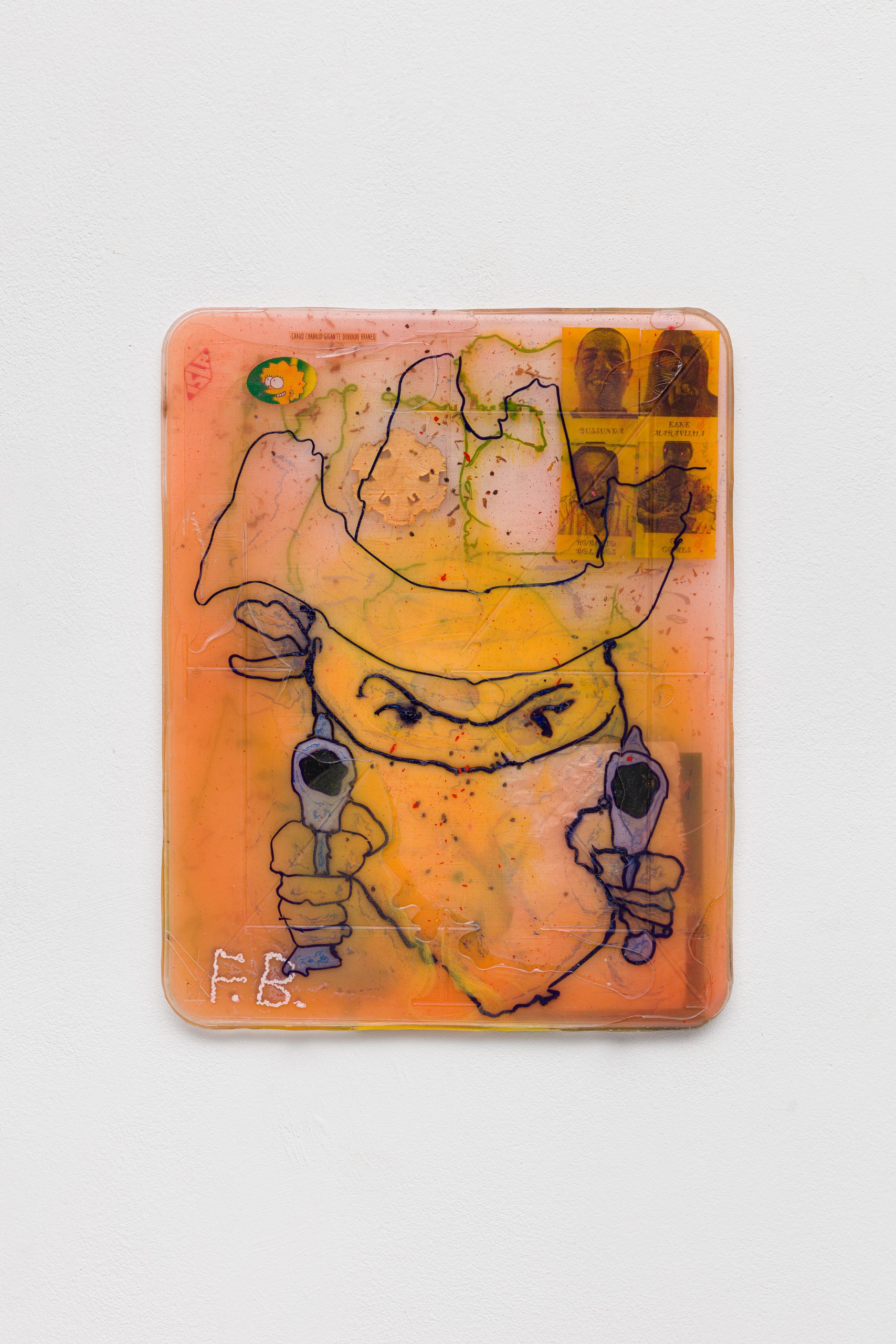
A segunda sala é ocupada por trinta e dois trabalhos seriais que têm como suporte bandejas.
Desativadas de sua função original, elas tornam-se superfícies de sedimentação de restos visuais: manchas, cores, fragmentos de referências culturais e pequenos acidentes materiais.
Cada bandeja registra encontros fortuitos entre imagens e gestos.
Como se fosse uma arqueologia do consumo recente — camadas sucessivas onde certos gestos retornam e se depositam.
O artista abdica deliberadamente do controle sobre o resultado final.
Montadas de forma serial e circular no espaço expositivo, as obras produzem uma espécie de circuito fechado.
Um outro loop.
Mais do que simples suportes, essas superfícies passam a operar como pequenas máquinas de repetição.
Dispositivos onde o gesto, o erro e o acaso retornam incessantemente.
A repetição obsessiva dessas superfícies evoca duas patologias fundamentais do presente: a compulsão e o esgotamento.
Não apenas a compulsão do consumo, mas também o reflexo diagnóstico de uma sociedade que transforma cada desvio em transtorno — e também em desejo.
Talvez, porém, essa repetição não seja apenas o signo de uma patologia.
Pode ser também a persistência de algo que insiste em retornar.
O problema torna-se sintoma.
O sintoma torna-se diagnóstico.
E o diagnóstico encontra sua solução no consumo farmacológico, fechando assim o circuito da própria patologia.
Na última sala, uma série de pequenas pinturas apresenta os problemas em sua forma mais direta: a linguagem.
Cada obra é nomeada de maneira literal, quase esquemática, como se os títulos fossem já a própria imagem.
As pinturas repetem o traço simplificado da figura animada do vídeo inicial.
Prendendo o espectador em um mesmo circuito narrativo.
Também nessa sala encontra-se Live Action, uma grande pintura acompanhada de uma esteira de caminhada.
O visitante é convidado a caminhar enquanto contempla a imagem.
Transformando-se no próprio problema do vídeo Problemas.
O corpo do espectador entra no sistema compulsivo do loop.
Andar sem sair do lugar.
Avançar sem deslocamento real.
A experiência mistura máquina e organismo, exercício físico e contemplação estética, saúde e performance.
Trata-se do paradigma perfeito da subjetividade contemporânea.
Um sujeito permanentemente em movimento, permanentemente ativo, mas preso em um circuito fechado de produtividade, autocorreção e cansaço.
Em Problema Meu, Barsuglia radicaliza sua investigação sobre os dispositivos que moldam a sensibilidade contemporânea.
O humor funciona como uma superfície de sedução.
Mas, por trás dele, emerge uma crítica mais dura: a percepção de que vivemos imersos em uma gigantesca máquina de repetição simbólica.
Uma máquina que produz problemas na mesma velocidade em que promete solucioná-los.
Talvez exista apenas para garantir que o loop nunca termine.
abrication of identity—as if contemporary subjectivity were confined to screens.
But the regime of images is far more vast and diffuse. It runs through banal objects, disposable surfaces, and small everyday artifacts that, quietly, constitute a parallel economy of signs.
Lighters, cigarettes, T-shirt prints, caps, cards, loose scraps of paper—this entire field of cultural debris, rapidly produced and discarded, is in fact one of the most effective laboratories of contemporary sensibility.
It is within this seemingly trivial field that Felipe Barsuglia operates.
He produces images from what he gathers among residues, working with the symbolic detritus that remains after consumption.
His gesture consists of displacing these objects into an aesthetic regime where they cease to be utilitarian and begin to reveal the logic that sustains them: the infinite circulation of signs, without origin or destination, which in the process affect subjectivity itself.
For this reason, Barsuglia performs this operation not as a resolution, but as a problem.
In Problema Meu (My Problem), his third solo exhibition at Galeria Sardenberg, Barsuglia begins with an apparently banal observation: everyone has problems.
The phrase, repeated to exhaustion in everyday life, becomes here a kind of minimal unit of contemporary experience—a universal sign so generic that it no longer belongs to anyone in particular.
After all, we all have problems.
The exhibition begins with Problemas (Problems), a looping video.
In it, an animated figure passes through a sequence of small mishaps: a stone in the path, a stumble, an uncontrolled fall, until finally “going down the drain.”
The narrative of failure is accompanied by an equally absurd soundtrack: the applause of an invisible audience.
Failure becomes spectacle.
The fall turns into performance.
Error is celebrated as if it were a triumph—or perhaps there is no longer any difference between the two.
In the same room stands Ailgusrab 2.
A pair of old sneakers tied together by their laces hangs from the wooden truss that supports the roof.
On the sole appears the word ailgusrab, an anagram of the artist’s surname reversed.
The name appears in a series of videos in which celebrities, proto-celebrities, friends, and people the artist loves and admires repeat this meaningless word in a mechanical loop, as if responding to an interview.
When played in reverse, the nonsense reveals the artist’s name.
Language here no longer communicates.
It folds back on itself, circulates in temporal inversion, and turns into pure symbolic noise through an abrupt cut.
Here, in its second incarnation, the first pair of sneakers was thrown onto the electrical wires in front of the artist’s studio.
The work evokes the exhaustion of the piece of clothing we use to walk—like the tireless figure that appears in Problemas.
But it also points toward the exhaustion of the objects that will appear in the works of the second room, now converted into another surface of meaning.
The second room is occupied by thirty-two serial works that use trays as their support.
Deactivated from their original function, they become surfaces where visual residues accumulate: stains, colors, fragments of cultural references, and small material accidents.
Each tray records fortuitous encounters between images and gestures.
As if it were an archaeology of recent consumption—successive layers where certain gestures return and settle.
The artist deliberately relinquishes control over the final result.
Installed serially and in a circular arrangement within the exhibition space, the works produce a kind of closed circuit.
Another loop.
More than simple supports, these surfaces begin to operate as small machines of repetition.
Devices where gesture, error, and chance return incessantly.
The obsessive repetition of these surfaces evokes two fundamental pathologies of the present: compulsion and exhaustion.
Not only the compulsion of consumption, but also the diagnostic reflex of a society that transforms every deviation into disorder—and into desire.
Perhaps, however, this repetition is not only the sign of a pathology.
It may also be the persistence of something that insists on returning.
The problem becomes symptom.
The symptom becomes diagnosis.
And the diagnosis finds its solution in pharmaceutical consumption, thus closing the circuit of pathology itself.
In the final room, a series of small paintings presents problems in their most direct form: language.
Each work is titled in a literal, almost schematic way, as if the titles were already the image itself.
The paintings repeat the simplified line of the animated figure from the initial video.
Trapping the viewer within the same narrative circuit.
Also in this room is Live Action, a large painting accompanied by a treadmill.
The visitor is invited to walk while contemplating the image.
Becoming the very problem from the video Problemas.
The spectator’s body enters the compulsive system of the loop.
Walking without leaving the place.
Advancing without real displacement.
The experience merges machine and organism, physical exercise and aesthetic contemplation, health and performance.
It is the perfect paradigm of contemporary subjectivity.
A subject permanently in motion, permanently active, yet trapped within a closed circuit of productivity, self-correction, and fatigue.
In Problema Meu, Barsuglia radicalizes his investigation into the devices that shape contemporary sensibility.
Humor functions as a surface of seduction.
But behind it emerges a harsher critique: the perception that we live immersed in a gigantic machine of symbolic repetition.
A machine that produces problems at the same speed with which it promises to solve them.
Perhaps it exists only to ensure that the loop never ends.
Imagens / Images




Exposições / Exhibitions
-
SP-Arte Rotas: Pinturas de Ressaca
Felipe Barsuglia
solo show
exposição individual
-
Plim Plim
Felipe Barsuglia
solo show
exposição individual
-
Apocalipse Now
collective show
exposição coletiva
-
Medo de Gente
collective show
exposição coletiva
-
Legal
Felipe Barsuglia
solo show
exposição individual