É sobre isso e tá tudo bem
Breno Liguori
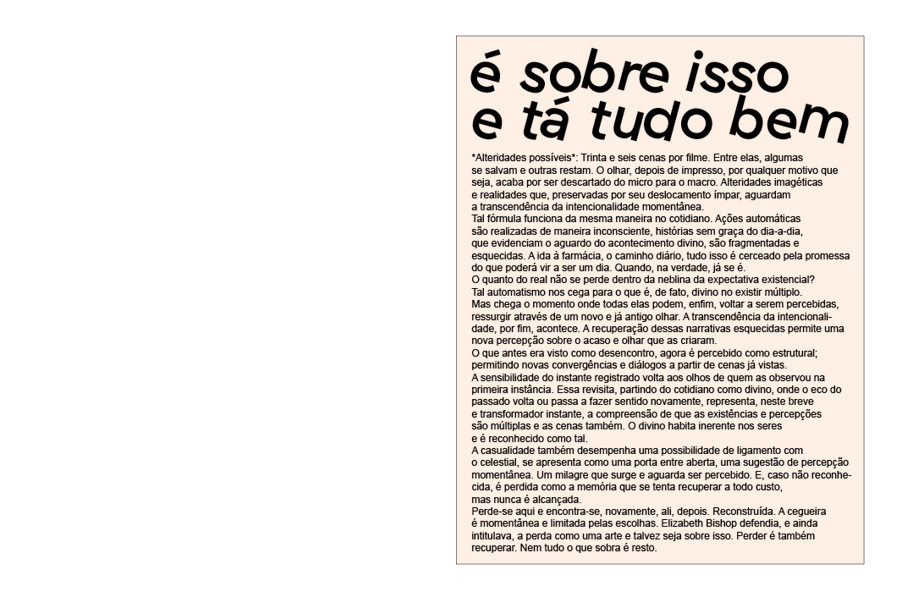
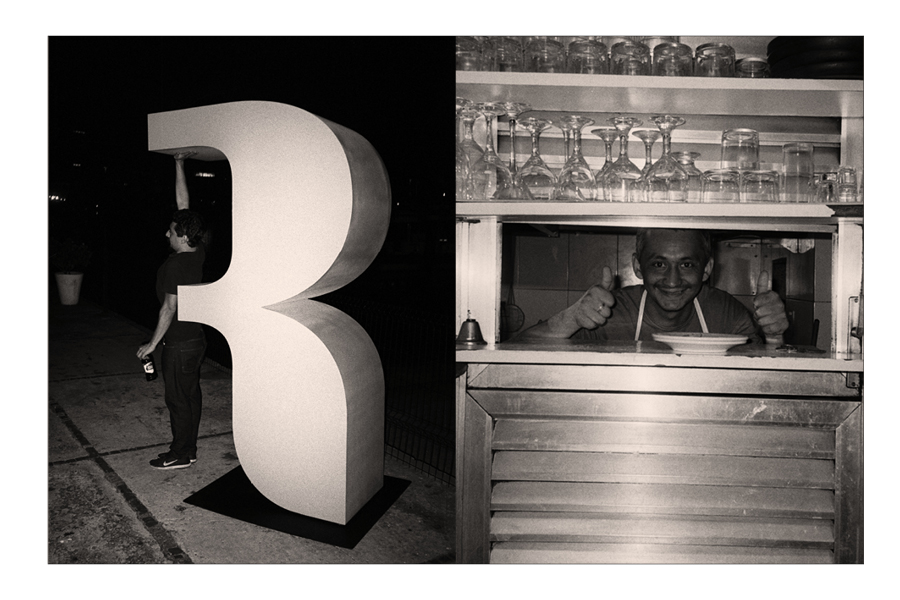
Alteridades possíveis: Trinta e seis cenas por filme. Entre elas, algumas se salvam e outras restam. O olhar, depois de impresso, por qualquer motivo que seja, acaba por ser descartado do micro para o macro. Alteridades imagéticas e realidades que, preservadas por seu deslocamento ímpar, aguardam a transcendência da intencionalidade momentânea.
Tal fórmula funciona da mesma maneira no cotidiano. Ações automáticas são realizadas de maneira inconsciente, histórias sem graça do dia-a-dia, que evidenciam o aguardo do acontecimento divino, são fragmentadas e esquecidas. A ida à farmácia, o caminho diário, tudo isso é cerceado pela promessa do que poderá vir a ser um dia. Quando, na verdade, já se é. O quanto do real não se perde dentro da neblina da expectativa existencial?
Tal automatismo nos cega para o que é, de fato, divino no existir múltiplo. Mas chega o momento onde todas elas podem, enfim, voltar a serem percebidas, ressurgir através de um novo e já antigo olhar. A transcendência da intencionalidade, por fim, acontece. A recuperação dessas narrativas esquecidas permite uma nova percepção sobre o acaso e olhar que as criaram.
O que antes era visto como desencontro, agora é percebido como estrutural; permitindo novas convergências e diálogos a partir de cenas já vistas. A sensibilidade do instante registrado volta aos olhos de quem as observou na primeira instância. Essa revisita, partindo do cotidiano como divino, onde o eco do passado volta ou passa a fazer sentido novamente, representa, neste breve e transformador instante, a compreensão de que as existências e percepções são múltiplas e as cenas também. O divino habita inerente nos seres e é reconhecido como tal.
A casualidade também desempenha uma possibilidade de ligamento com o celestial, se apresenta como uma porta entre aberta, uma sugestão de percepção momentânea. Um milagre que surge e aguarda ser percebido. E, caso não reconhecida, é perdida como a memória que se tenta recuperar a todo custo, mas nunca é alcançada.
Perde-se aqui e encontra-se, novamente, ali, depois. Reconstruída. A cegueira é momentânea e limitada pelas escolhas. Elizabeth Bishop defendia, e ainda intitulava, a perda como uma arte e talvez seja sobre isso. Perder é também recuperar. Nem tudo o que sobra é resto.
Texto: Breno Liguori
Possible alterities: Thirty-six scenes per movie. Among them, some are saved and others remain. The gaze, once printed, for whatever reason, ends up being discarded from the micro to the macro. Imagetic alterities and realities that, preserved by their unique displacement, await the transcendence of momentary intentionality.
Such a formula works in the same way in everyday life. Automatic actions take place unconsciously, dull everyday stories, which show that we are waiting for a divine event, are both fragmented and forgotten. The trip to the drugstore, the daily commute, all of this is curtailed by the promise of what could be one day. When, in fact, you already are. How much of the real is not lost in the fog of existential expectation?
Such automatism blinds us to what is, in fact, divine in multiple existence. But there comes a time when all of them can finally be perceived again, re-emerge through a new and already old gaze. The transcendence of intentionality finally takes place. The recovery of these forgotten narratives allows for a new perception of the chance and gaze that created them.
What was once seen as a mismatch is now perceived as structural, which allows for new convergences and dialogues based on scenes that have already been seen. The sensitivity of the recorded instant returns to the eyes of those who first observed it. This revisit, starting from everyday life as divine, where the echo of the past returns or starts to make sense again, represents, in this brief and transformative instant, the understanding that existences and perceptions are multiple and so are the scenes. The divine dwells inherently in beings and is recognized as such.
Chance also plays a possible link with the celestial, presenting itself as a door between openings, a suggestion of momentary perception. A miracle that appears and waits to be perceived. And, if it is not recognized, it is lost like the memory that you try to recover at all costs, but never reach.
It is lost here and found again, there, later. Reconstructed. Blindness is momentary and limited by choices. Elizabeth Bishop defended, and still does, loss as an art, and perhaps that’s what it’s about. To lose is also to recover. Not everything that remains is leftovers.
Text: Breno Liguori
Imagens / Images




Exposições / Exhibitions
-
Problema Meu
Felipe Barsuglia
solo show
exposição individual
-
SP-Arte Rotas: Pinturas de Ressaca
Felipe Barsuglia
solo show
exposição individual
-
Plim Plim
Felipe Barsuglia
solo show
exposição individual
-
Apocalipse Now
collective show
exposição coletiva
-
Medo de Gente
collective show
exposição coletiva